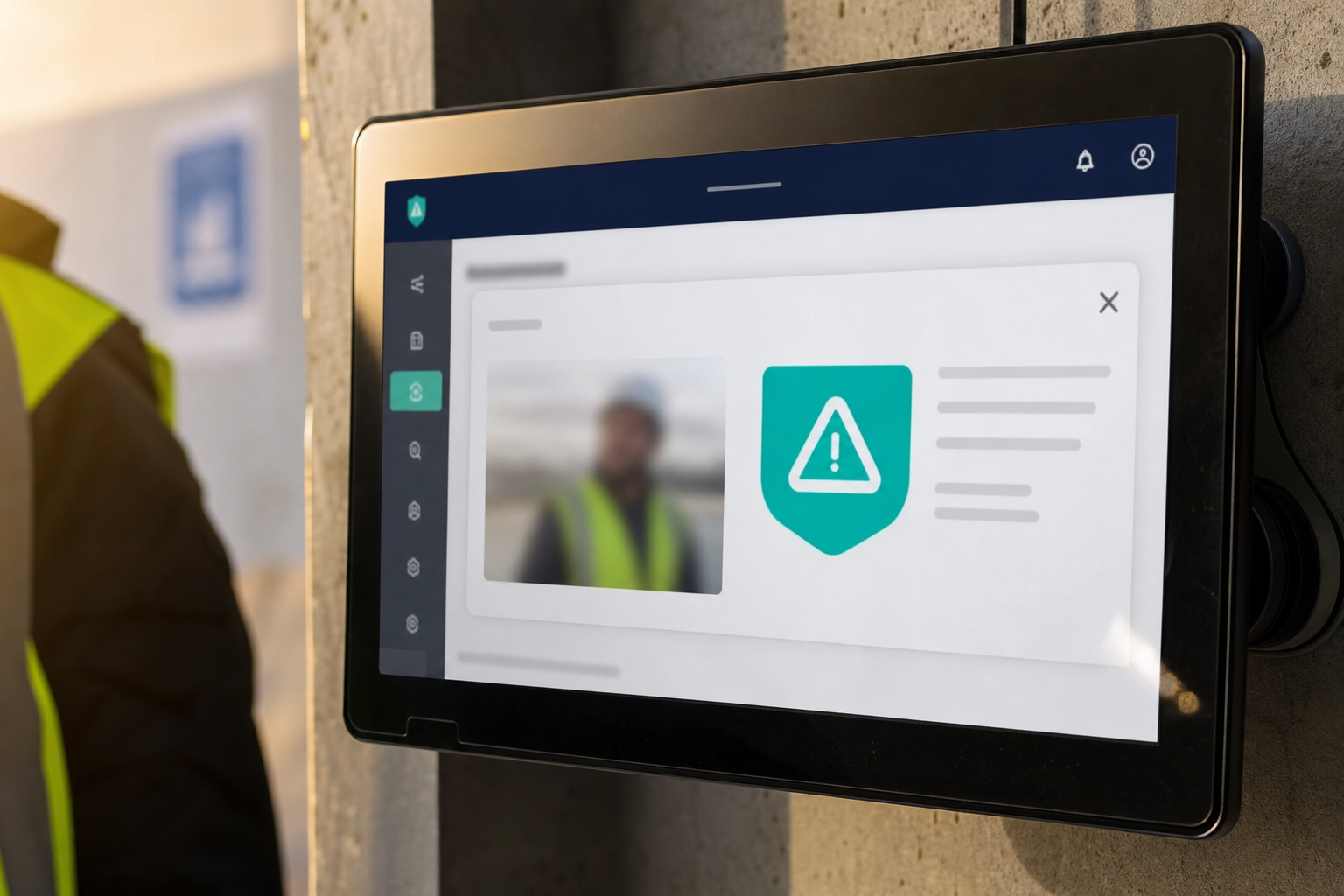
When Off-the-Shelf Computer Vision Fails: and How Bespoke Models Win
By Ramy Morcos · · 8 min read
Monday site induction. Forty workers. Three camera angles. An off-site PPE trial flags twelve violations in the first hour; nine are false. The safety manager turns it off by Wednesday.
Generic computer vision works in a demo video. It fails on your site: golden-hour glare on hard hats, high-vis vests that read orange in one camera and yellow in another, workers twenty metres from the lens. That is where a bespoke-build service - trained on your cameras and your rules - earns its keep.
> Quick answer: Off-the-shelf vision models are trained on generic datasets; bespoke models are trained on your cameras, lighting, and layout, which cuts false positives on site-specific rules like PPE.
At a glance
→Three failure modes: training mismatch, camera geometry, no retraining loop.
→Bespoke pipeline: assess, design, build, deploy on edge, refine quarterly.
→Alert fatigue kills adoption faster than missed detections in safety use cases.
→Off-the-shelf may suffice for simple indoor trials; outdoor multi-camera sites rarely.
→Buyer checklist: data custody, retraining, integration, kill criteria.
In this article
→Why do off-the-shelf models fail?
→What is the bespoke vision pipeline?
→What does a construction PPE deployment look like?
→Where else does bespoke vision apply?
→When is off-the-shelf enough?
→What should buyers ask vendors?
→Where Vision Engineering fits
→The bottom line
Why do off-the-shelf models fail?
Computer vision is a measurement instrument, not a download. It must be calibrated to your environment. Three recurring failure modes:
Training data mismatch
Models trained on open datasets rarely match your mounting height, vest colour, or helmet type. A model trained on US hard hats hallucinates violations on a Sydney site at sunset when scaffolding colour and sun angle differ.
Camera geometry and distance
Far-field accuracy drops beyond optimal range. One wide-angle shot cannot resolve PPE detail at the back of a 12,000 m² yard. Pixel count on a vest stripe at 25 metres is not the same as at 5 metres.
No retraining loop
Sites change: new slab, relocated hoarding, seasonal sun. Static models drift. False positives return; staff stop trusting alerts. Without retraining cadence, week-one demo accuracy is the peak, not the floor.
What does a construction PPE deployment look like?
Tier-1 commercial build · Sydney metro · 14-storey core
Challenge: Principal contractor needed continuous hard-hat and high-vis monitoring across the ground-level active zone, not spot checks twice a day. Off-the-shelf model purchased online achieved ~40% false positive rate on dusk shifts (vests misread as background; scaffolding confused with helmets).
Approach: NeuraIQ trained on footage from this site's cameras - same mounting heights, same west-facing glare at 4pm - rather than generic stock datasets. Deployed on an on-premises appliance; alerts to the site safety officer with a snapshot, not a raw stream.
Results (6 weeks): False positives down to actionable levels; safety officer trusts alerts again. Violations logged with timestamp for toolbox talks, not punitive auto-fines. Zero video left the site for inference. Retraining scheduled when level 3 slab changed camera sightlines.
Single camera, stable indoor lighting, binary use case
Generic may suffice for a trial
Multi-camera, outdoor, regulatory audit trail
Bespoke + edge deploy
Alert fatigue already killed a prior pilot
Bespoke retraining essential
Short temporary site under 8 weeks
Manual spot checks may beat setup cost
Honest vendors tell you when download-and-pray is enough. We say no when glare, distance, or compliance stakes guarantee alert fatigue.
What should buyers ask vendors?
1.Whose frames train the model? Yours or a public dataset from another continent?
2.What precision on my pilot after week two? Not ImageNet benchmarks.
3.Retraining cadence and trigger events? Layout change, season, new PPE supplier.
4.What bytes leave the building? Labelled exports vs live stream upload.
5.Integration and alert owner? Who gets SMS at 4pm Friday?
6.Kill criteria? If false positives per day exceed X, stop or retrain.
Demand a false positive rate trend over 90 days, same discipline as retail loss prevention evaluations.
Where Vision Engineering fits
Vision Engineering is NeuraIQ's bespoke computer vision practice for Australian industrial, construction, logistics, and manufacturing sites. We label from your cameras, train site-specific models, deploy on the NeuraIQ edge appliance, and maintain retraining when your site changes.
Retail pharmacy shrink uses a separate productised path (IntelliGuard); Vision Engineering is for rules generic models cannot hold on your footage.
The bottom line
Off-the-shelf CV is a starting point, not a finish line. When false positives kill adoption, bespoke vision engineering on your premises, with a retraining plan, is how safety and ops teams actually use the system Monday through Friday.